Metadata
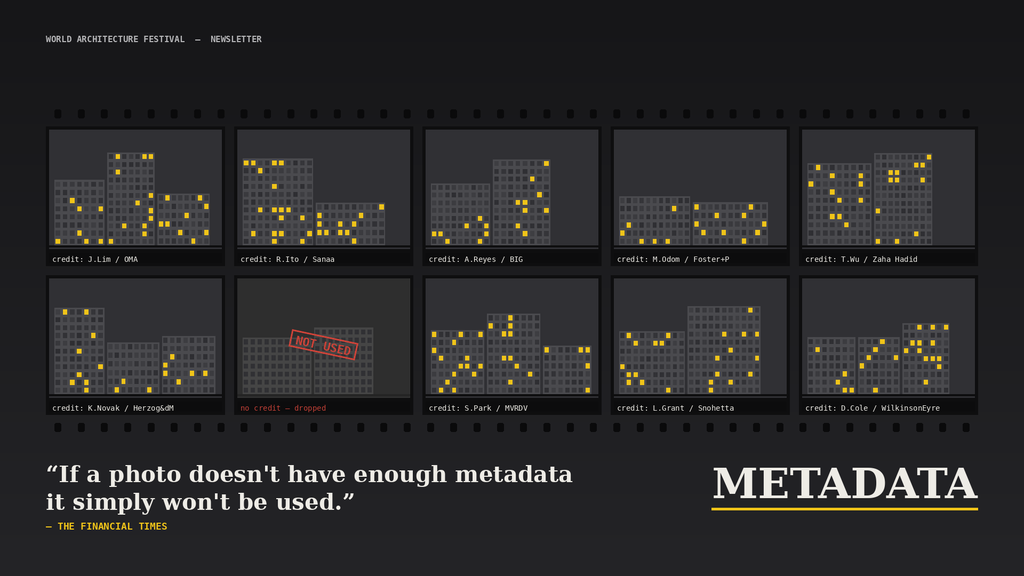
'If a photo doesn't have enough metadata it simply won't be used' - The Financial Times.
"Companies have to start looking at their documents and files—their content—not just as something they’re storing but as critical business intelligence,” so says Amy Machado, Senior Research Manager for Enterprise Content and Knowledge Management Strategies, IDC in the Wall Street Journal Business, 2nd September 2026, and it all evolves around metadata, writes Lynne Bryant.
Metadata is the basis for future workflow and AI development.
For those who have embraced metadata this is a nursery conversation, but wherever you are on the metadata journey do read the WSJ article.
Many may utilize metadata internally but it's surprising how one outward facing application often slips below the radar.
Have you ever seen one of your projects published and you're not mentioned? Consider a relationship with your client, key contractors and your photographer were terms of engagement include being named in the metadata.
"I would go as far as to recommend that every commission includes a contractual obligation to include and preserve metadata."
Anna Skurczynska, Partner at OpenPlanLaw,
a solicitor with extensive experience in visual arts IP and lecturer in media ethics and law. (openplanlaw.com)
In the January 2024 edition of the WAF Newsletter, I illustrated the ease of setting up and understanding a metadata template. Less favourable feedback was 'this is just so photographers can get a credit'
- well there's nothing wrong with that - but it's not only for photographers, it lifts all creatives and can be a basis for search and retrieval.
Metadata improves a companies visibility.
Have you even had a conversation about metadata with your photographers? And what about your marketing and communications department?
'If a photo doesn't have enough metadata, it simply won't be used.'
- The Financial Times
The photographer should deliver digital images with basic metadata and a metadata conversation is an opportunity to ensure the photographer enters the correct practice name and project name.
I know that we have often entered the project name our client uses - but that is not necessarily the official name.
Metadata applies to video as well as stills and a commissioned photographer/ videographer is the copyright holder.
In the UK, deliberate removal of metadata that identifies the copyright owner is unlawful.
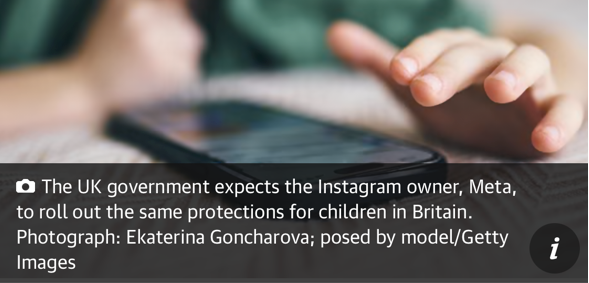
Machine extracted headline and credit as seen in the Guardian on-line.
Another reason to have a conversation is to consider a shared attribution in the 'Credit' field.
The architectural practice will be named in the metadata but if the machine reader is selective in the extraction fields they could still be missed. A negotiated shared credit line might work.
The IPTC metadata credit line may be:
Credit Line: Joe Photo for ABC Architects.
One line of metadata and both creatives covered.
Agree the basics, and at a later date, for example, keywords can be added.
"Across museums, archives and marketing teams, metadata is the quiet engine that makes digital collections work. It’s how people find the right image, the right plan, the right story. The richer and more consistent the metadata, the more valuable the collection becomes. A digital asset without metadata isn’t really an asset at all — it’s just a file waiting to be found. " Nick Caw, CEO - Capture Ltd (capture.co.uk)
Metadata should be included in all digital documents.
Photographs and video are only one element, but they are an element that ' goes out into the world' and should have embedded attribution.
It's your future and our legacy.
Musings from my life in photography and architecture ©Lynne Bryant 2026This may not be scraped or copied without prior permission from Lynne Bryant.
Founder Partner