
From Bilbao to Havant Thicket
I took off recently for a week’s motorcycling in the Picos de Europa, the spectacular mountain range in northern Spain, writes Paul Hyett. Arriving late in Bilbao on my rented BMW F800GS (pictured), I headed into town to revisit the Guggenheim Museum, which I first saw 25 years ago. It still looks stunning, those quilted titanium cladding panels glistening in the dark as if new.
Frank Gehry specified the product at a moment of great serendipity: Russia had recently dumped massive stockpiles of the material onto the global market, following its decision to decommission its titanium-hulled Alpha-class submarines. This caused a market crash, allowing just about the world’s most expensive metal to be acquired for the museum at a unit price below that of stainless steel. (Almost immediately after, global prices shot back up, more than doubling.)
Because titanium is exceptionally strong and corrosion-resistant, it was possible to roll the panels to a mere 0.38mm – half the thickness otherwise needed for stainless steel. This drastically reduced the total volume and weight of metal needed, leading happily to further economies for the museum.
To achieve the fluid curves wanted for the facades, Gehry’s team turned to CATIA, an advanced aerospace software programme originally developed for fighter jets. At that time, 2D architectural tools could neither describe nor calculate the complex, non-repetitive geometries that Gehry envisioned. By translating the architect’s physical paper and wooden models into precise three-dimensional digital representations, the software could map the exact curvature of every single titanium shield. Structural stresses were then calculated mathematically, ensuring that none of the panels would warp or buckle under heavy wind loads.
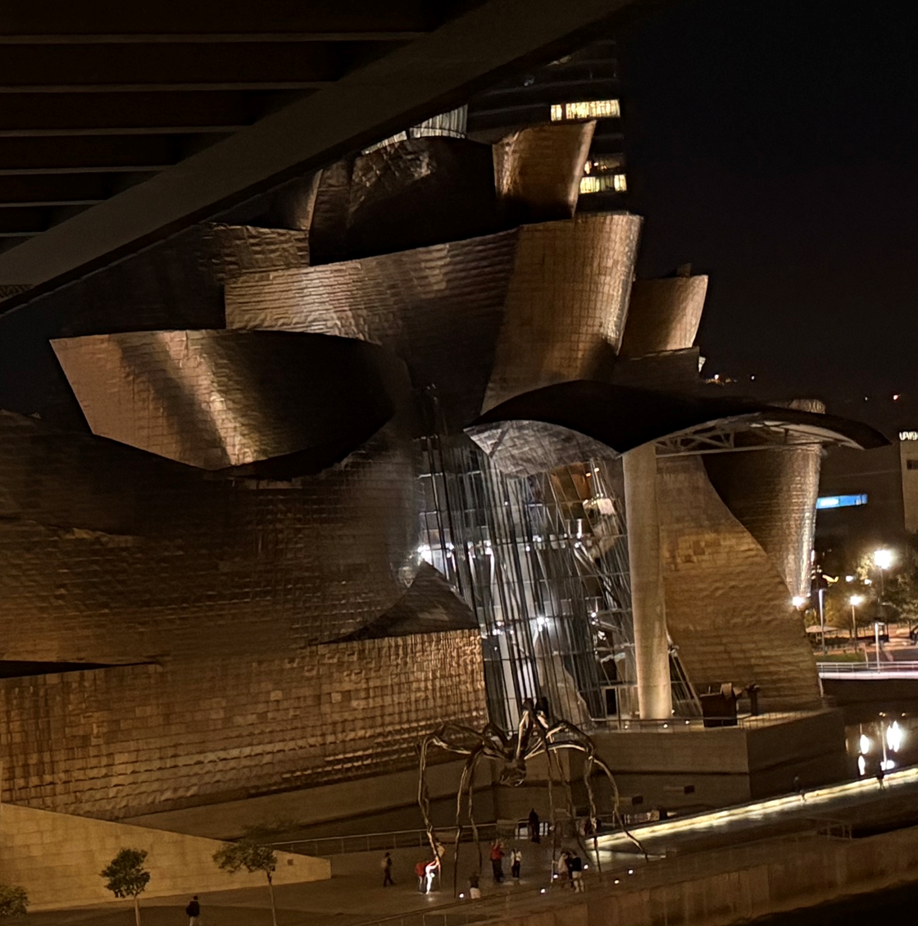
Guggenheim north-facing façade viewed from Puente de la Salve.
And there certainly are strong winds along that northern seaboard, as I discovered the following day: motor-cycling west to the Picos, I was cruelly buffeted by unsettling gusts, especially when crossing the many high bridges spanning estuaries along the coastline.
For a very different architectural experience, I stopped by the Basilica de Santa Maria la Real de Covadonga, a stunning Romanesque church built towards the end of the 19th century. Featuring distinctive twin towers, it was constructed entirely from a most beautiful pink limestone quarried directly from nearby Peñalba.
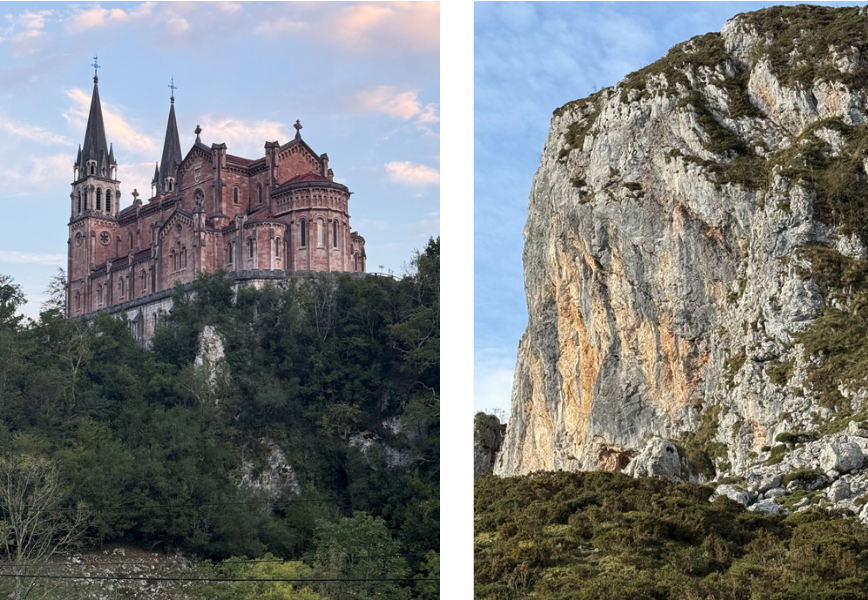
Basilica de Santa Maria la Real de Covadonga Picos Mountains: pink limestone
Across from the Basilica is the Sanctuary de Covadonga with its famous cliffside grotto chapel set high above a small and enchanting lake. Long on my ‘bucket list’, it was great finally to be there.
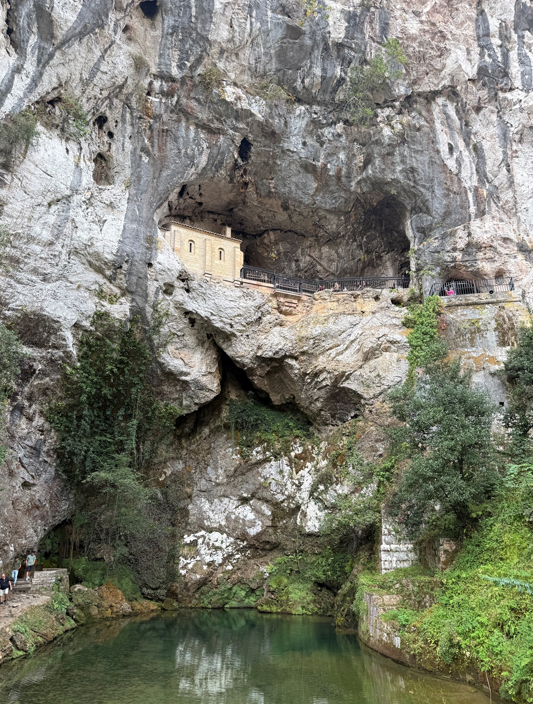
Sanctuary de Covadonga with its cliffside grotto chapel
Visits to Sotres, following a breathtaking climb up the steepest of roads, and later to Santillana del Mar and Cangas de Onís, further enriched my experience. There I found a spectacular arched footbridge below which hangs a splendid wooden crucifix.
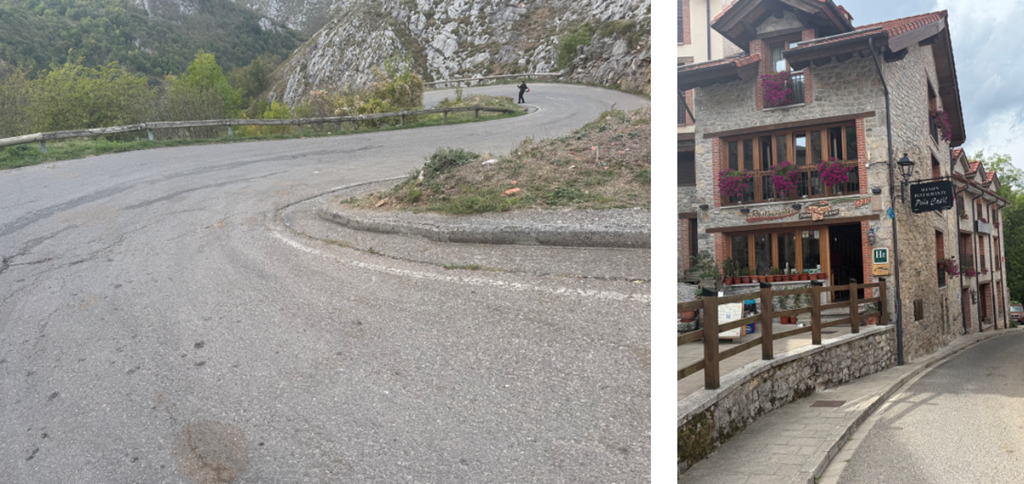
Fearsome climb to Sotres Restaurante Pena Castil at Sotres
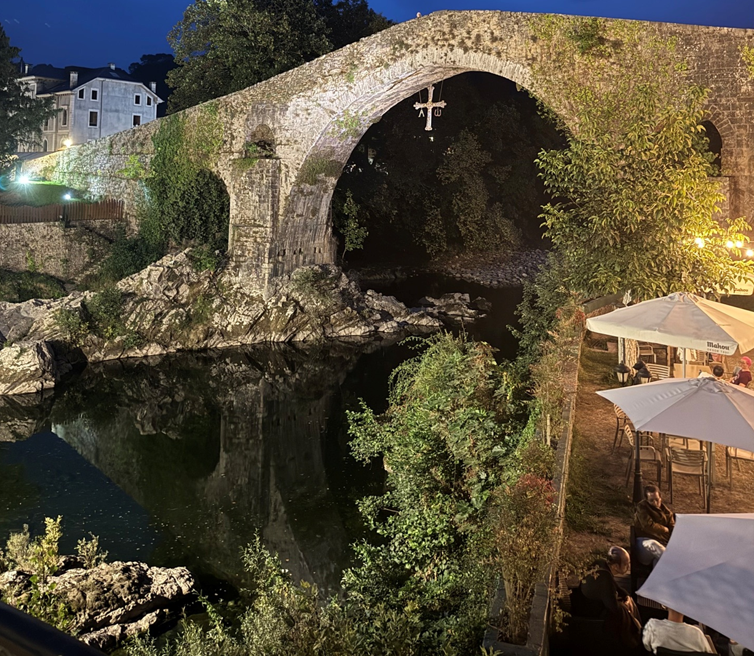
The Puente Romano at Cangas de Onís
But most moving of all was the view from a bench near the church of San Martín from where, high above the newly constructed Riaño Reservoir, I watched a beautiful sunset. There, I thought about the anguish suffered by the thousands of people who were forcibly evicted from their homes in order to facilitate the reservoir’s construction. Many of the submerged villages had histories stretching back centuries. The forced evictions triggered aggressive protests, demonstrations and blockades, with local residents famously chaining themselves inside their churches before security services intervened to remove them.
Eventually, 22 years after construction started, the Spanish government ordered the filling of the reservoir on 31 December 1987.
The church of San Martín was moved, stone by stone, from the flooded village of Pedrosa del Rey and relocated in New Riaño, a seemingly vibrant town (but banal in its architecture), that was built on the shore of the new reservoir. Next to the church, supported within a bizarrely modernist white space frame, hung the church bells of all the flooded and demolished villages within the valley.
Sadly, the preservation of such artefacts offered little to those whose loved ones had been buried in the now-flooded cemeteries. To protect against a public health crisis, and the macabre possibility of remains rising to the surface when the valley filled, the government enforced their sealing under thick layers of concrete before the floodgates opened. For the families this was a devastating psychological blow.
The fate of the villages beneath Riaño remained in my thoughts after returning home. Quite unexpectedly, those reflections resurfaced the very next day in Effingham, a small town 30 miles south-west of central London. There, in the beautiful parish church of St Lawrence, can be found the grave of Barnes Neville Wallis of ‘Dambusters’ fame (Wallis designed the ‘bouncing bomb’ used during the famous World War II air raid). Of the three German dams attacked on the night of 16 May 1943, the Möhne and Eder were both breached, while the Sorpe, although damaged, remained intact. They were respectively 31, 29 and 8 years old, and their construction had required the decanting of five villages and 1,600 people. Again, the village’s respective graveyards had been sealed beneath concrete and stone.
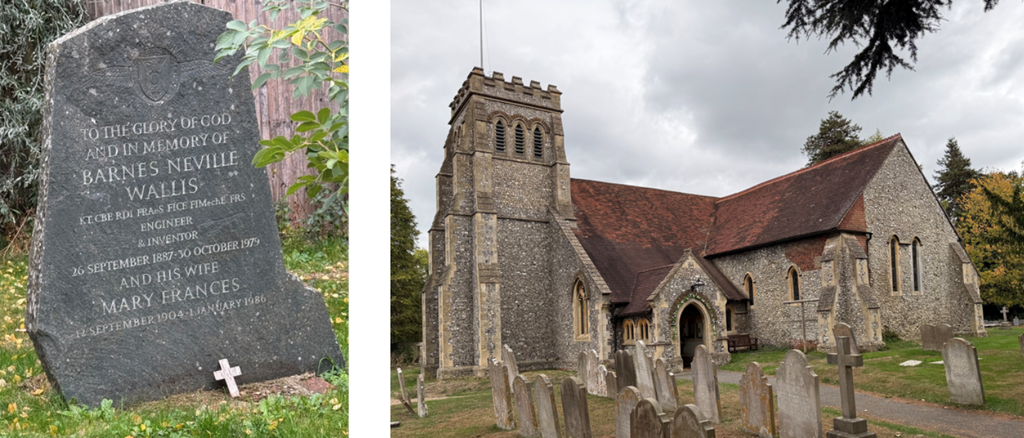
The tombstone St. Lawrence Parish Church
There was another, rather more personal, connection for me in Effingham: Wallis had tested his bouncing bomb using scale models on a small lake at the Building Research Establishment (BRE). There, a plaque still records the experiments. Coincidentally, I was the architect for the nearby Fire Research Testing Station on the same campus, completed in 1998 and subsequently featured in the Architects’ Journal (it made the cover). A pleasing, if unexpected, link between my own architectural career and Barnes Wallis.
Standing at his grave, I found myself wondering what has happened to Britain’s reservoirs since Wallis’s time?
A little research reveals that our country is currently engaged in the largest expansion of water infrastructure in decades, with government backing for a programme of new major reservoirs, all in England. These are required to prevent a five-billion-litres-a-day water shortfall otherwise anticipated by 2055. Notably, no major reservoir has been built in the UK since 1991.
Due to the care with which the sites have been chosen, no villages will be submerged, and only a few individual homes and some infrastructure will be impacted. The map below shows the locations of the proposed new sites.
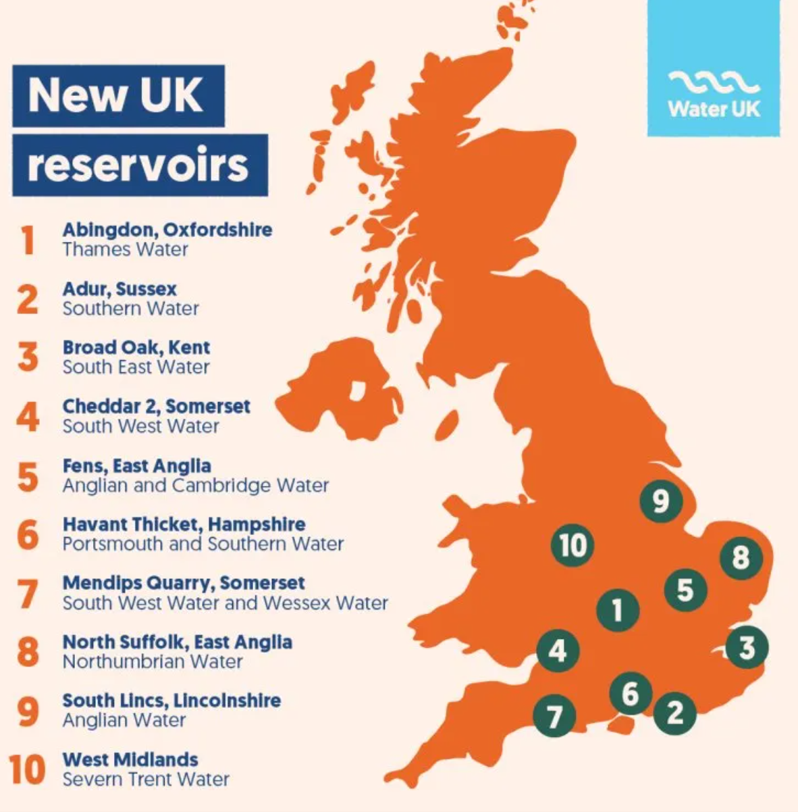
The locations of England’s new reservoirs
Unlike traditional mountain dams built within V-shaped valleys, such as those in central Wales that serve Birmingham’s needs, the proposed new sites are predominantly on flatter terrain. They will often require massive clay embankments to hold the water. The first of these, already under construction, is at Havant Thicket, 48 miles from Effingham.
But as with Riaño, despite the modest adverse impact in social terms and the potential amenity benefits of newly created wetlands, sailing lakes and wildlife habitats, the plans for these much-needed reservoirs have already generated heavy opposition.
Activists such as GARD (Group Against Reservoir Development) have joined with local district councils to object to these projects, pointing to claimed risks of local flooding, and arguing that water companies should fix leaking pipelines and invest in on-shore desalination plants before destroying farmland. Yawn . . .
A reality check is needed: new housing at the scale currently being mooted – 1.5 million homes by the end of this Parliament – will be useless without water, and it is plainly evident that the increase in England’s population of 11.72 million since our last reservoir was built (at Carsington Water, in Derbyshire) provides a compelling case for these new reservoirs.
That is why it is encouraging that the delays and legal gridlocks so common to major infrastructure projects are being addressed through the Government’s new Planning & Infrastructure Act. Under this legislation, major water infrastructure may be treated as ‘nationally significant infrastructure projects’, bringing them within national planning frameworks, thereby reducing the ability of local authorities to delay or block approvals.
Such issues are hardly uniquely British. Two weeks ago I was in China, where the extraordinary expansion of high-speed rail has involved seemingly endless networks of elevated track criss-crossing the country. The same utilitarian dilemma arises there on a vastly greater scale: infrastructure brings enormous benefits to millions, but its construction can impose profound costs on communities, particularly in rural areas. From Spain to Britain to China, the uncomfortable question remains the same: how much harm can reasonably be imposed on a minority in pursuit of a greater good?
The uncomfortable truth is that major infrastructure has always required society to decide the appropriate balance. This brings us to Jeremy Bentham, his philosophy of utilitarianism, and its maxim supporting ‘the greatest good for the greatest number’. In pursuit of balance, however, we must be mindful about suffering: those whose loved ones are now buried under concrete beneath the Riaño Reservoir have my deepest sympathy.
Infrastructure is, and always will be, necessary. But necessary does not mean morally cost-free.
Founder Partner