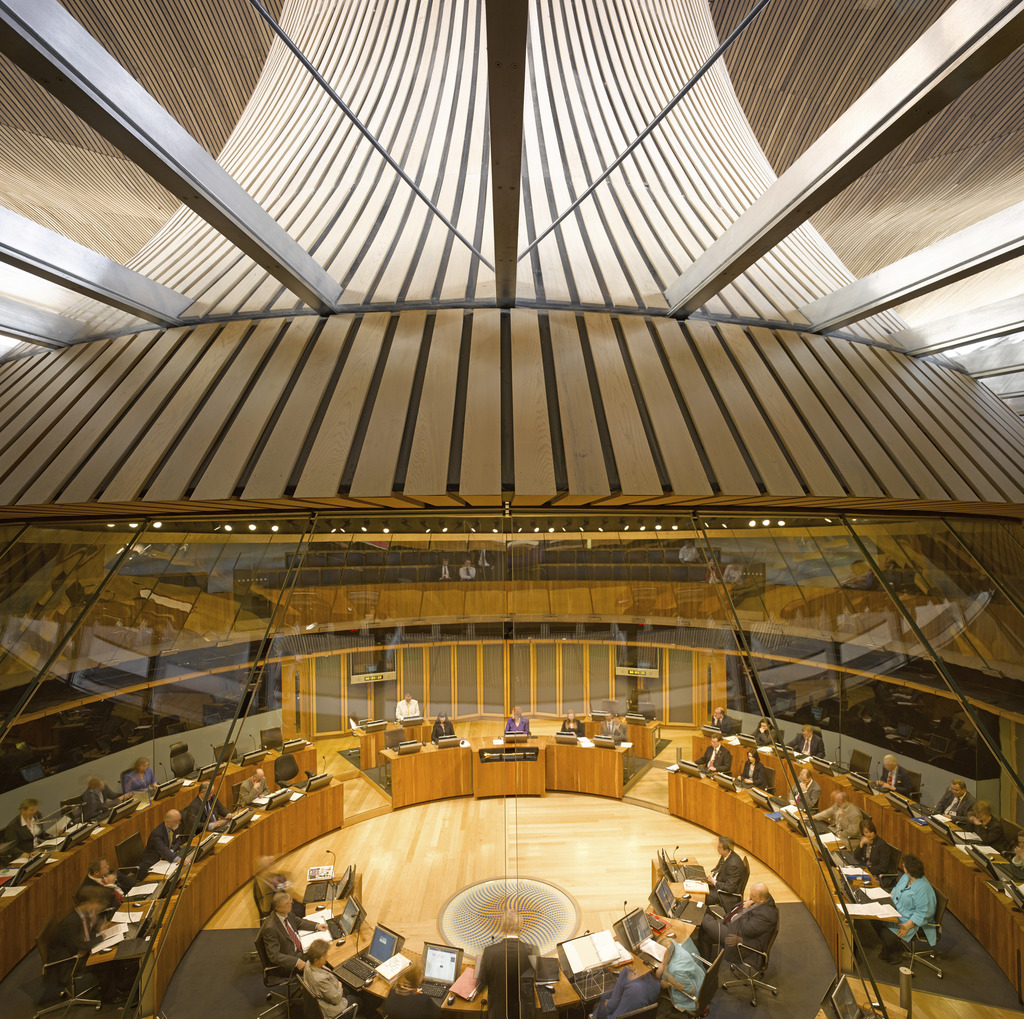
A Cardiff success story
In 1997, the UK’s incoming Labour government under Tony Blair promised plebiscites on devolution for Scotland and Wales, writes Jeremy Melvin.
They had been constituent parts of the UK since 1707 (in Scotland’s case) and at least the 15th century in Wales’. The former voted for devolution by a landslide, but Wales was more cautious: of the half of the electorate who voted, 50.3 per cent opted for devolution. Devolution went ahead nonetheless, and in the flush of Blair’s ‘Cool Britannia’ and apparent embrace of contemporary culture, both countries acquired new homes for their devolved assemblies the Edinburgh parliament was designed by Enric Miralles and Benedetta Tagliabue, and the Cardiff equivalent by Ivan Harbour of what was then the Richard Rogers Partnership, later Rogers Stirk Harbour & Partners and now simply RSHP.
Its design and recent adaptation have allowed the institution to rise far beyond the banal slogans of the ‘Cool Britannia’ era, and what passed for Blair’s political philosophy, indicating a series of possible relationships between city and public building, nature and urban, ruler and ruled. As such, it has some significance to the contemporary turmoil in democracies and parliaments.
Since completion in 2005, it has been the home of the national assembly, known as the Senedd Cymru or Senedd, and since 2020 recognized as a parliament. This evolution and expansion of its role, as well as other demographic changes in Wales has led to its expansion, from 60 to 96 members. The growth of devolved powers increased members’ workloads, with select committees to scrutinize legislation proliferating as well as longer and more plenary sessions. The increase in numbers should, at least in theory, improve the process of governance. RSHP completed the adaptation of the chamber in time for the newly expanded parliament to meet shortly after the regional elections of 7 May 2026.
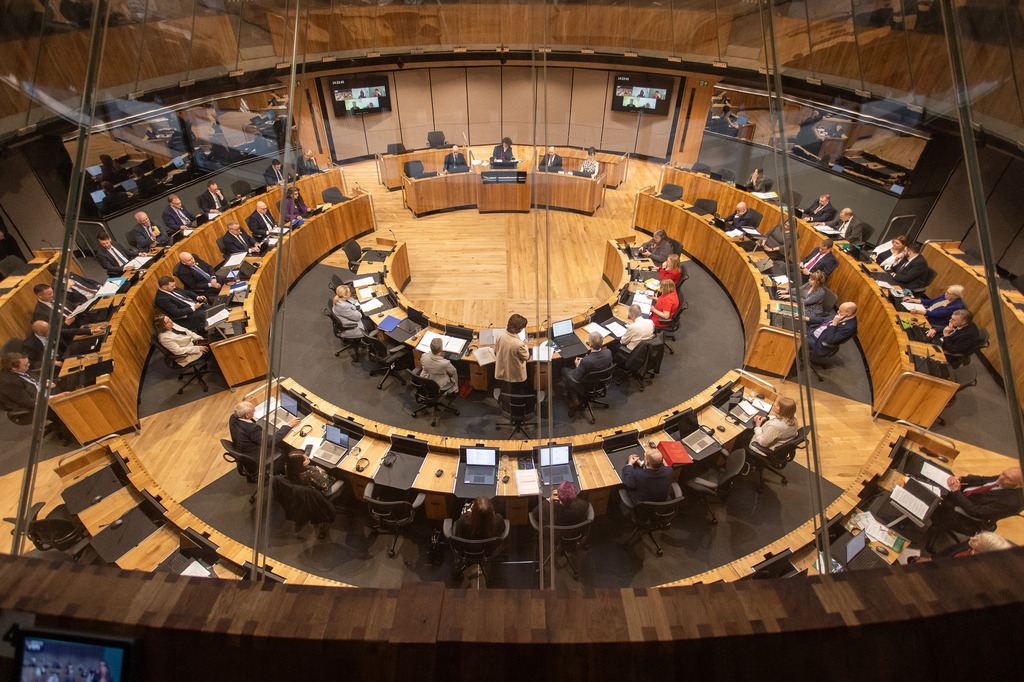
The remodelled chamber in session
Cardiff, the Welsh capital, is part of a conurbation running along the coast of South Wales which also includes Newport, Port Talbot, and Swansea. All were important industrial centres, Swansea for metallurgy while Cardiff was the world’s largest coal port. This left several marks: residual industrial wealth in Cardiff Castle (designed by William Burges for the 3rd Marquess of Bute, whose family owned much of the city), an Edwardian neo-classical civic centre described by Nikolaus Pevsner as the finest such ensemble in Britain, and the huge docks. More or less redundant since the closure in the coal mines in the 1980s and 90s, there was an ambition to turn the dock into a large leisure district, with a barrage across the bay to minimize tidal movement (the Bristol Channel to which it leads has some of the strongest tides in the world) and to turn it gradually into freshwater.
There was no precedent for a country-wide parliamentary assembly, as Wales was annexed to England before parliamentary government took root. So site selection provoked a great deal of debate which touched on the ambitions for the country, the city, and the institution. Two final choices emerged, Cardiff City Hall in the centre, and a magnificent but isolated site in the docks, adjacent to a splendid Edwardian terracotta pierhead building, which was the just about the only survivor of the once thriving life of the docks. As part of the plans for regeneration the dockland site was selected. It is adjacent to the site of what would have been Zaha Hadid’s Cardiff Opera House, which was ultimately supplanted by the clumsy leviathan of the Millennium Centre. It houses musical and theatrical performances in several auditoria.
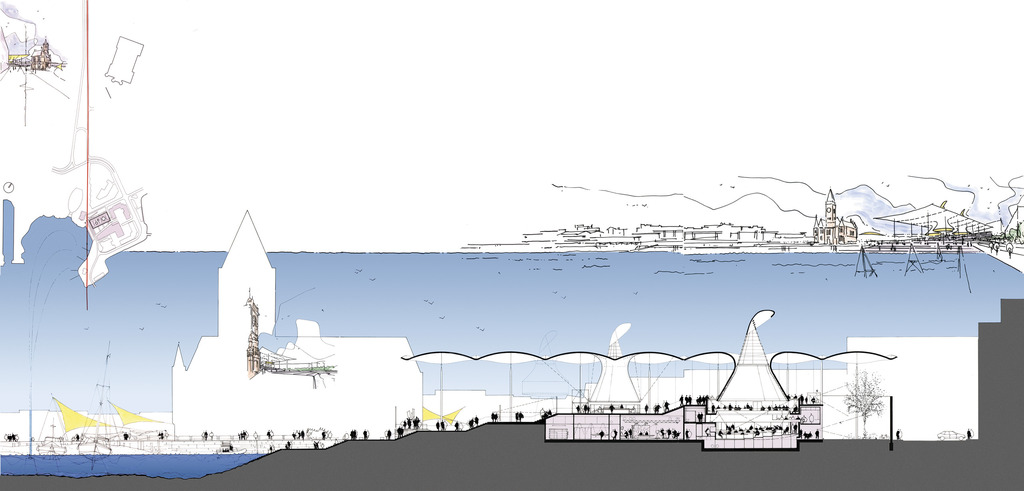
Long section through the building, the Pierhead building visible in background
In 1998, designing the new assembly posed complex challenges for RRP. They had not just to invent the architecture and public identity for a new institution, but also play a part in defining a new piece of public realm some way remote from Cardiff’s existing centre. RRP were well placed for both: Richard Rogers had recently been made a member of the House of Lords, in which he was an active member, and so brought direct experience of how parliaments work into the firm. He was also chair of the Urban Task Force – another Blairite initiative – which produced far-reaching proposals for regenerating rundown industrial cities and areas within them.
The site provided considerable inspiration, with the flat now non-tidal water meeting the slightly elevated land, under the busy Welsh sky. To the north, unseen, is the city centre and some way distant the Brecon Beacons; to the south, across the bay, is the Penarth peninsula with the Bristol Channel beyond. Ivan Harbour drew a striking image, diagrammatic in its simplicity but deeply resonant, that captures the essence of the design. It is essentially three lines, a horizontal one for the water, another above it, connected by a few steps, for the floor of the Senedd, and a third which starts as the sky, but deforms into a funnel shape just above the floor. This, symbolically, is the Senedd chamber, tying the land which provided Cardiff’s mineral wealth, with the water which allowed it to be exploited through exportation, and nature represented in the sky. Most parliament buildings, privileging rationality, exclude nature from their debating chambers: you would have to go to the original site of the Icelandic Ting (parliament), in a geological fault – part of the country’s active seismic formation – between the European and North American tectonic plates, to find a parliament whose members are confronted as viscerally with nature in the course of their work.
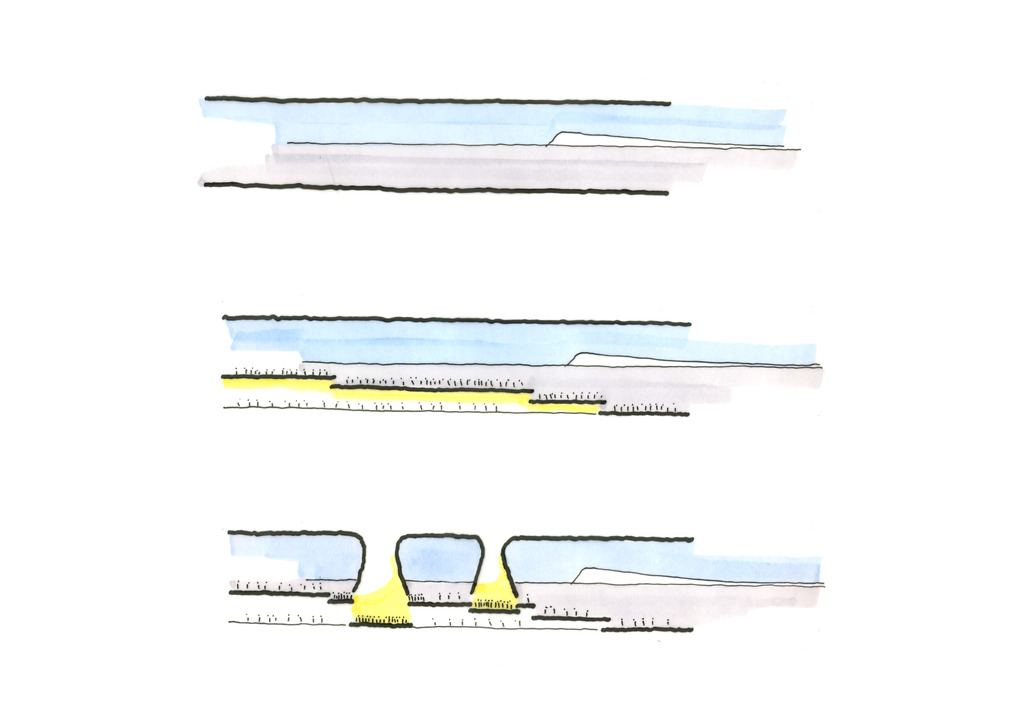
Ivan Harbour’s conceptual sketch
The scoop brings daylight into the chamber and is part of the highly successful sustainability strategy for the building. It was also designed to absorb some expansion of the original membership, a wise precaution given that it was a new and untested institution. The recent overhaul exploits this possibility.
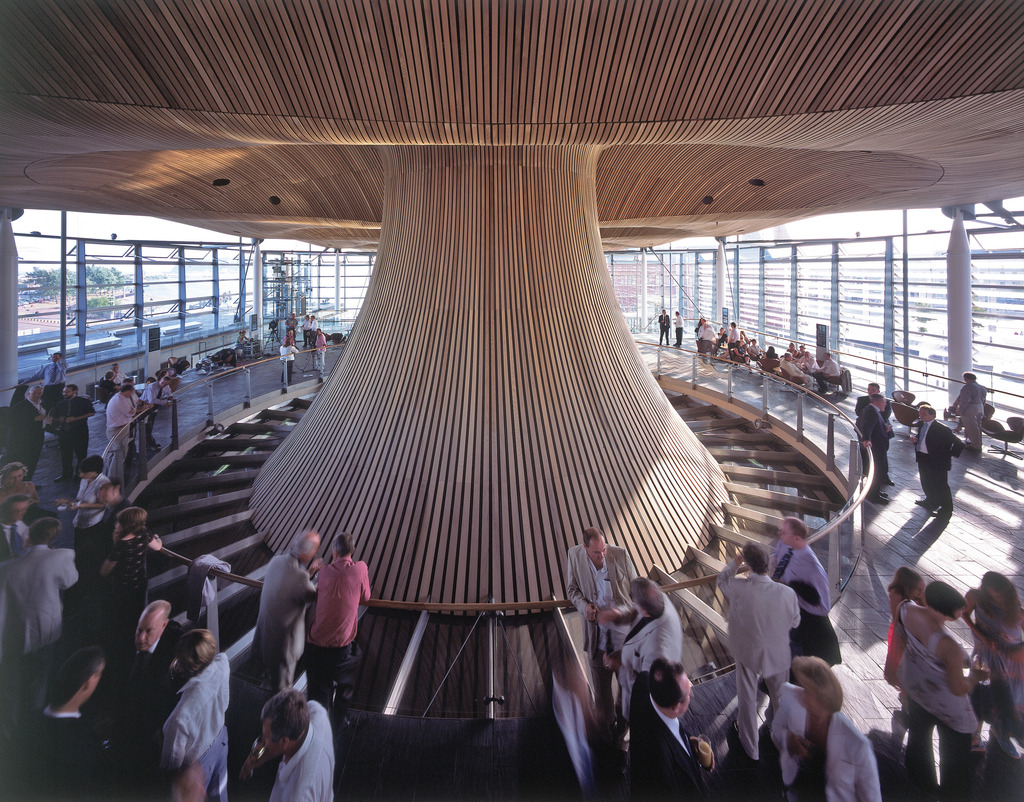
Members of the public looking down on their elected representatives
It is not just nature that impinges on the consciousness of the members. The composition, starting with horizontal lines linked by flights of steps, adds another level on the inside and one more on top. A large roof oversails the entrance and stairs from the waterfront, clearly marking its presence and status as an important public building. It gathers people and invites them up the stairs (despite a segue through security which came into the brief post 9/11 and does not significantly compromise the effect). Once in the entrance foyer, a further flight ascends to an upper level, with café, children’s play area and views down to the floor of the chamber. Here the public look down on their elected rulers while they are in session, which I believe is unique for parliament buildings, although an idea explored in Norman Foster’s Reichstag parliamentary building in Berlin via its public staircase looking down on the chamber. As Richard Rogers and his fellow peers sat in Pugin’s gilded chamber of the House of Lords in London, effigies of the barons who forced King John to sign Magna Carta in 1215 look down on them: in Cardiff members of the public play the same role of holding power to account.
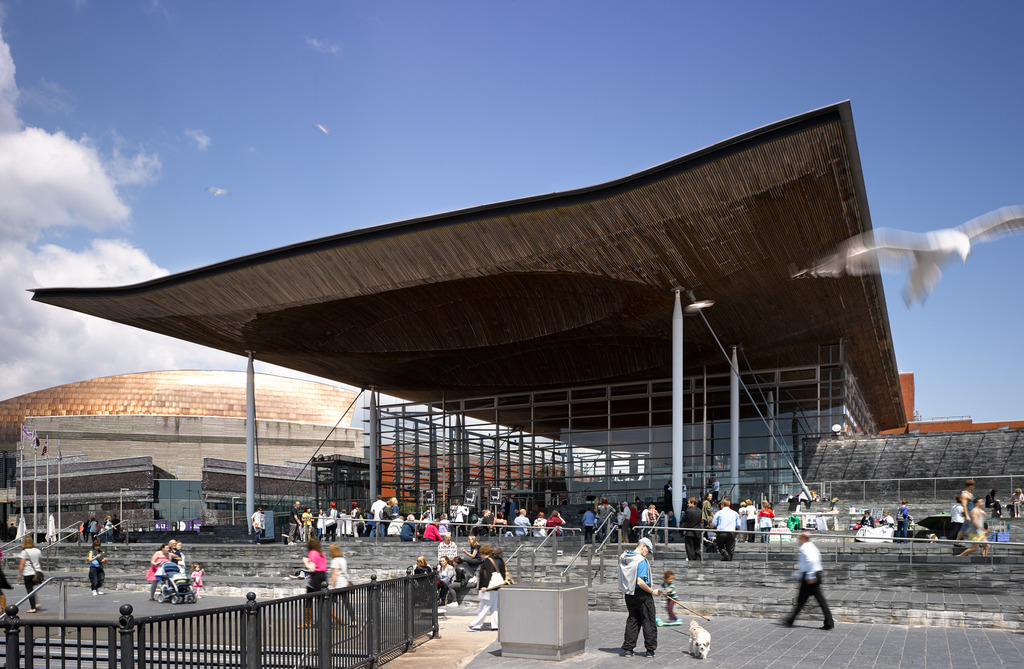
View from the waterfront
This touches on the core impression of the building: a complex and satisfying mix of formality and informality. The entrance sequence of oversailing canopy, stairs and foyer are grand without being intimidating, rising to the level with the viewing gallery and café it becomes less formal: here parents can bring children, schoolkids gather for educational tours and, it seems, members of the public can ‘hang out’. All of this seems appropriate to a modern democratic institution, implying that democracy is a process rather than a single event or sequence of events, that it works best when understood by and encourages participation from everyone. By contrast, the Palace of Westminster can overawe visitors, while neo-classical parliaments, the most common style, carry all sorts of implications of hierarchy and the authority of history. Some new parliaments may eschew these historic precedents, but can become overcomplicated or rooted in the zeitgeist at the time of their creation, such as Gunther Behnisch’s Federal Parliament building in Bonn, which German re-unification rendered redundant almost as soon as it was completed.
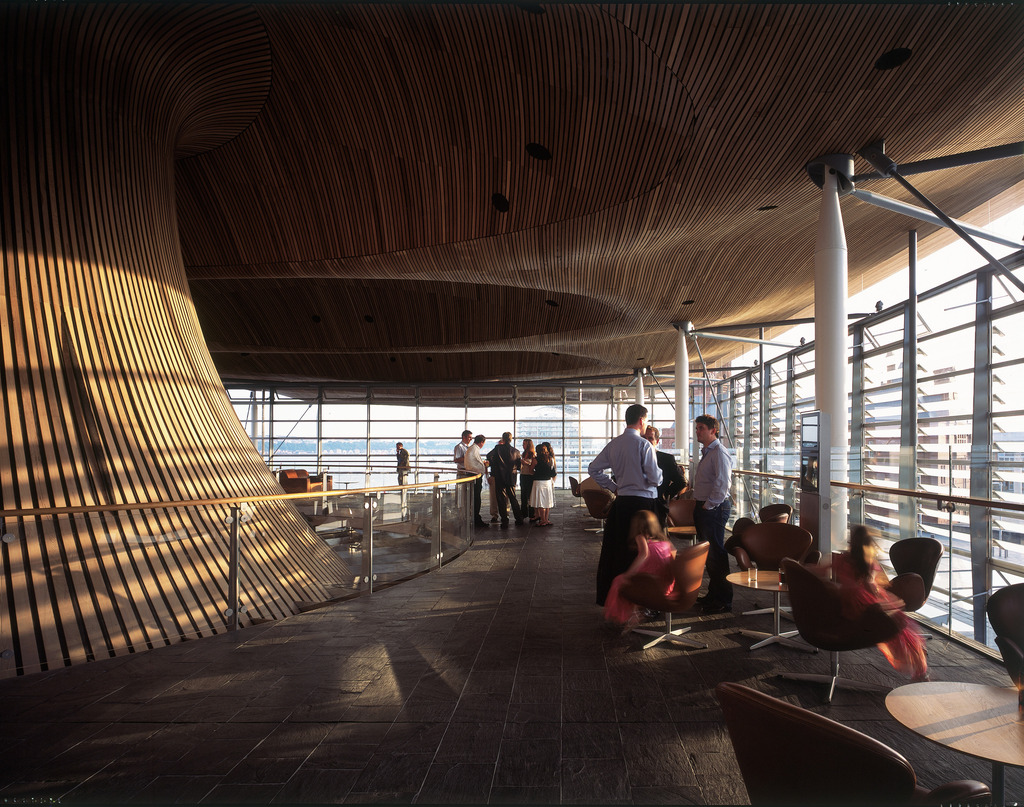
The first floor café and children’s play area
Cardiff is remarkable in retaining clarity of organization without imposing the finger of authority. There is never any doubt about the presence and importance of the debating chamber, which is at the centre of the building. It was, recalls Daniel Wright, the RSHP associate director overseeing the recent works and site architect for the last couple of years of the original construction, the product of considerable input from politicians as well as architects. He mentions in particular Dafydd Elis Thomas, a long standing and influential figure in Welsh Nationalism, who was the first Presiding Officer of the Assembly. The circular format was selected early, on the basis that it would make division between parties and factions less clear, and encourage collaboration and coalition. This has proven to be the case since the assembly was established, in part because the electoral system makes it difficult for any single party to gain a majority. A number of the members had or have since been members of the Westminster parliament, where coalitions are rare and single parties tend to command overall majorities.
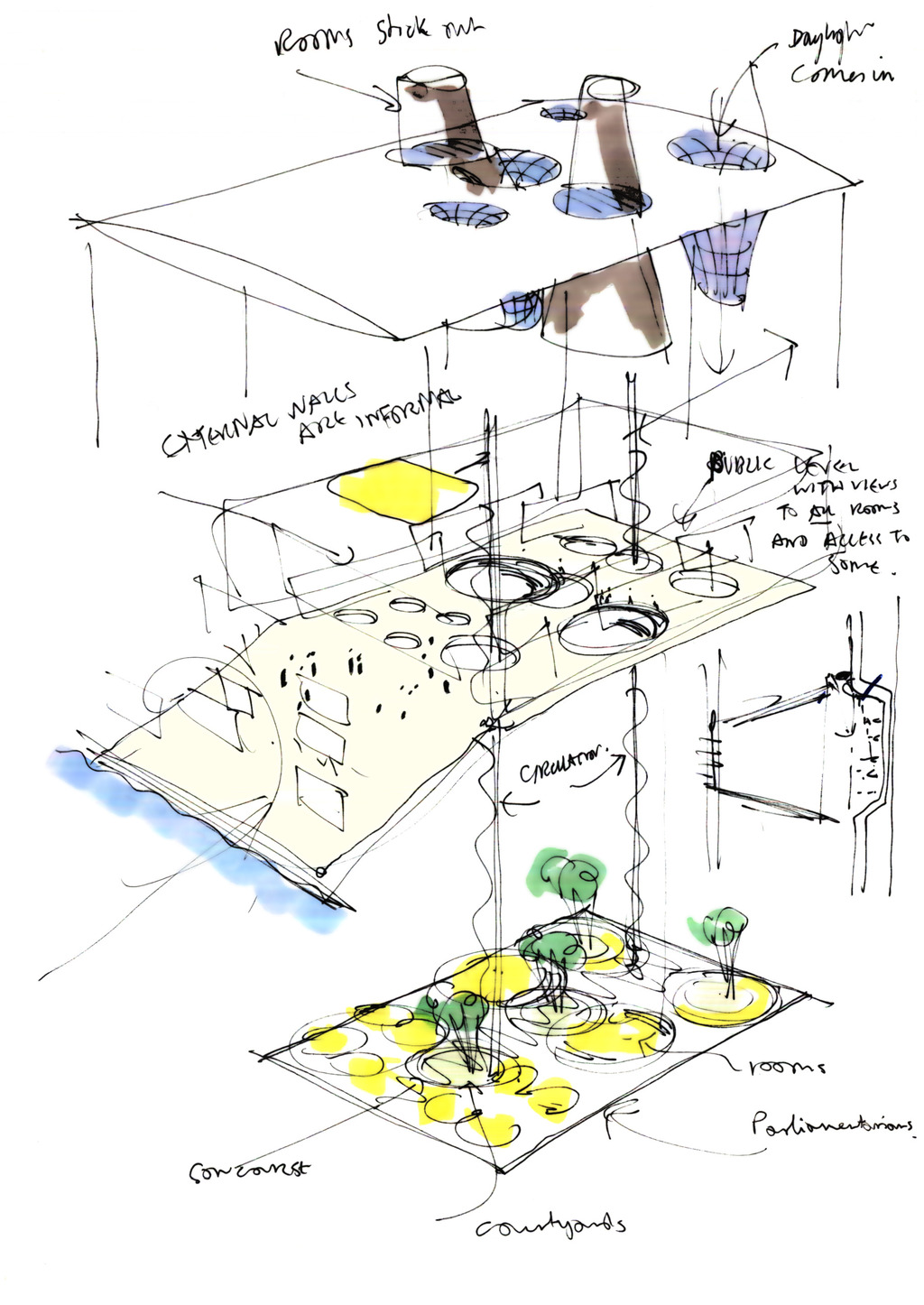
Exploded diagram of the original design
Elis Thomas was also instrumental in the finer layout of the chamber. Initially he wanted everyone on the same level, including himself as the presiding officer, but that proved impractical as he also needed direct sightlines across the chamber to all members, so this seat is slightly raised. There is also a need for simultaneous translation as the assembly was from the beginning completely bilingual between English and Welsh; translators need to be able to see each speaker directly.
All these factors made the layout of the chamber quite complicated. Though following a simple circular geometry with concentric rings of seats for members, with the presiding officer at the focus of the arc of those rings (backed up by clerks), the floor level needed intricate manipulation, leading to small steps between the rings, posing a challenge for mobility. A great deal of attention was lavished on the desks, with each seat having a desk in front of it with facilities for a laptop as well as various papers. When they stood to give a speech, they could rest notes on a Perspex stand placed on the desk, which was never considered wholly in keeping with the design.
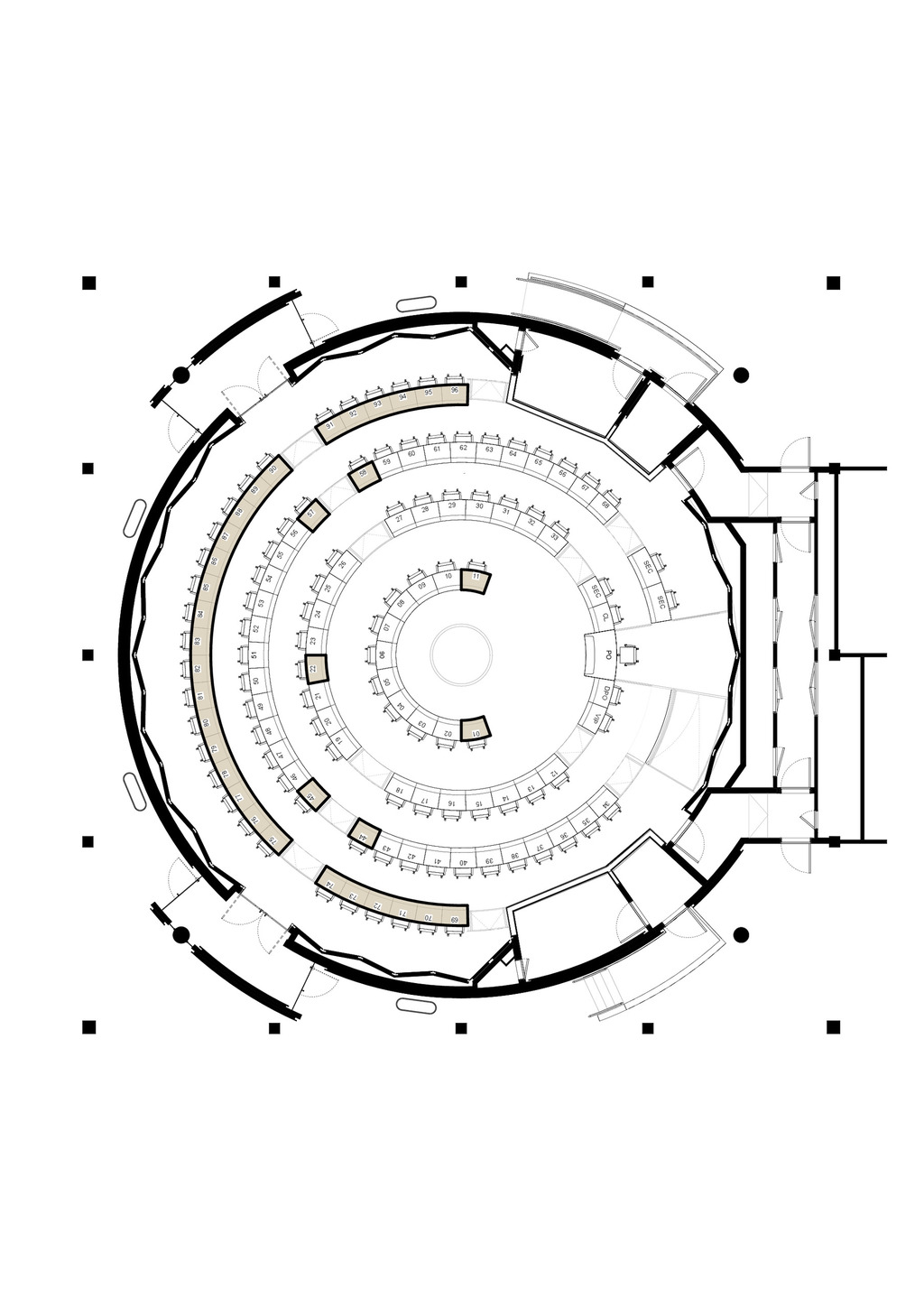
Plan of the updated chamber with new seats and the lobbies pushed beyond the chamber walls
So the expansion of the membership and the resulting need to adapt the chamber was an opportunity to improve it from its first iteration. As mentioned above, the chamber had more than enough space for the original contingent of 60, allowing for an extra ring of desks to be inserted on the same radius. The entry lobbies have been pushed to the outside of the circular geometry to accommodate this ring, and to minimize interference from outside the chamber. The backwall has been reclad partly in Welsh oak, the material also used for the desks.
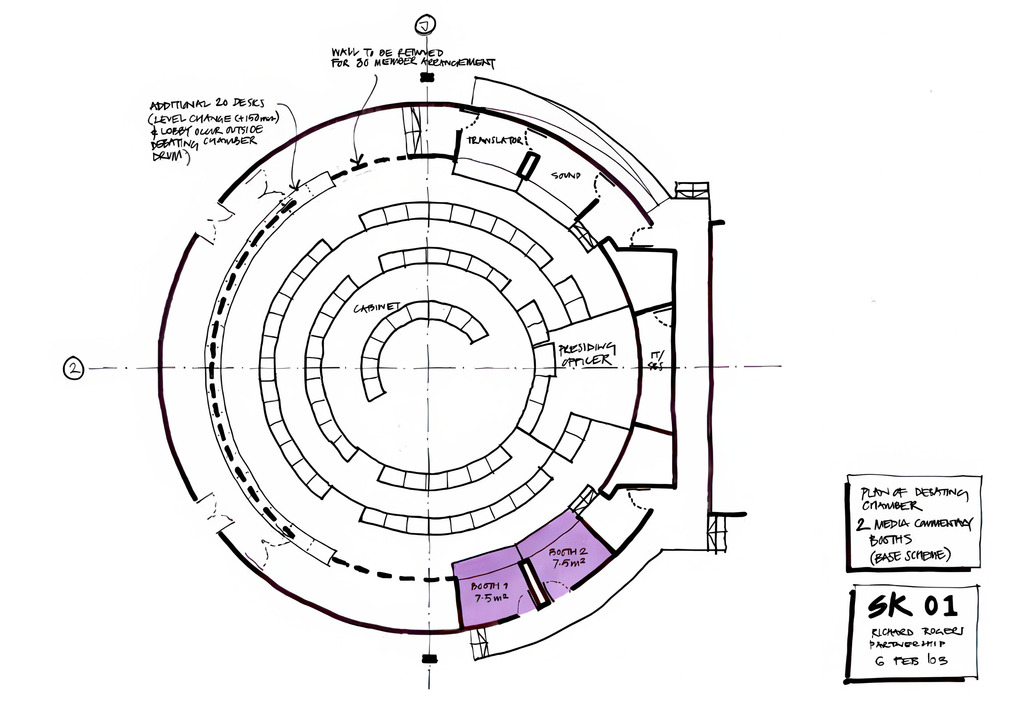
Plan showing the insertion of the extra 24 seats in an outer ring
Wright is especially proud of the reconfigured desks. While saving as much as possible of the original construction, they now incorporate a hinged stand for laptops, which can be activated at the right angle and height for a standing member, and folded away neatly when not in use. Members are not allocated specific desks, so they can sit at and log on at any available one.
When the Senedd was created in the wake of the plebiscite, it received rather less attention than the Scottish Parliament or the simultaneous negotiations over the constitutional arrangements for Northern Ireland, the UK’s third devolved region. There were several reasons for this: it was not the overwhelming choice of the Welsh people, and despite the historic importance of Wales to the Labour Party, it was in the 1997 government, eclipsed by a strong streak of Scottishness. To some extent the Senedd came into existence under the public radar, despite the dedication of many of its members and its architects. This may have been a real advantage, as it could evolve outside the spotlight. Most importantly is how the building has supported the institution’s evolution over its quarter century life. As its political gravity shifts with the election of 7 May 2026, that relationship between architecture and politics will be tested.
But making these adjustments to the chamber while reinforcing its original character is an impressive tribute to the strength of the original design. Whatever teething problems devolution may have had, the Senedd has provided a robust spatial framework within which it can grow, evolve and overcome its difficulties through debate, reflection and dialogue. No doubt it will continue to do so, despite Labour’s drubbing in the recent elections. That is another story.
Founder Partner